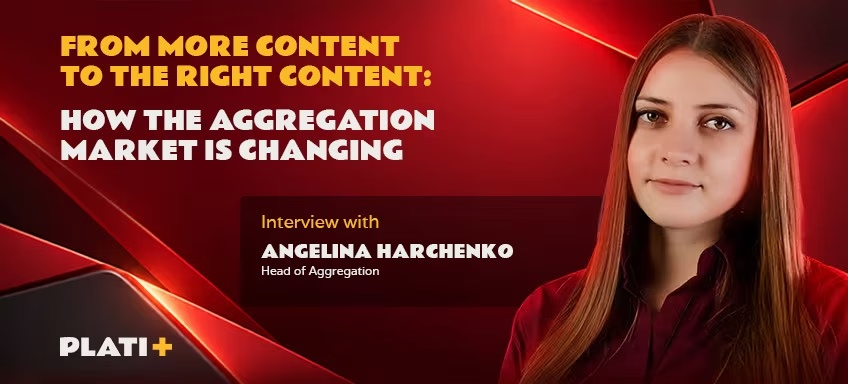
Interview with Angelina Kharchenko, Head of Aggregation at Plati+
The aggregation market has changed significantly in recent years. Operators can now access thousands of games through a single integration, new studios are entering the industry at an impressive pace, and simply offering a large content library is no longer enough to stand out.
We spoke with Angelina Kharchenko, Head of Aggregation at Plati+, about how aggregators discover new studios, what makes content commercially relevant, what operators are looking for today, and where the aggregation market is heading next.
1. With so many studios entering the market, how do you find new providers and decide which ones are worth exploring?
Finding new studios is a continuous process rather than something that happens through one particular channel. Industry events remain extremely important because they allow us to meet teams directly, see their products and understand the thinking behind them. But discovery also comes through operator requests, recommendations from partners, market monitoring and simply watching what is beginning to gain traction in different regions.
The bigger challenge today is not necessarily finding studios — there are plenty of them. It is identifying which ones can genuinely add something valuable to an existing portfolio.
When we look at a potential partner, we consider the product itself, of course, but also the markets they understand, their technical readiness, how flexible the team is, and whether there is a clear idea behind the content. A studio does not necessarily need hundreds of games to be interesting. Sometimes a relatively small portfolio can be much more valuable if it offers a distinctive mechanic, targets a specific audience well or brings something operators cannot easily find elsewhere.
For an aggregator, the question is increasingly not “How many games can this studio give us?” but “Why should an operator want these particular games?”
2. What makes a game studio relevant to operators today? Is having a strong product still enough?
A strong product is the starting point, but I would say it is no longer enough on its own.
Operators have access to an enormous amount of content, so every new studio is competing not only with similar suppliers but with thousands of games already available in the lobby. That changes what relevance means.
We look at whether the studio understands player behaviour, whether its games are suitable for the markets it wants to enter, how well the content performs on mobile, whether the mechanics are intuitive and whether there is something recognisable about the product.
Commercial relevance is also very market-specific. A studio can be extremely successful in one region and much less relevant in another. Player preferences, game formats, volatility, visual styles and even session behaviour can vary considerably between markets.
That is why I think the strongest studios today are those that know who they are building for. Trying to create a game for everyone can easily result in creating something that does not feel particularly relevant to anyone.
Something that has become increasingly important is a studio's PR and media presence. In practice, operators tend to gravitate towards content that is already visible — names they have seen discussed, reviewed or promoted across the industry. A studio that invests in building its own visibility makes it far easier for its games to gain traction, because there is already a level of recognition and trust before the content even reaches the lobby.
3. Are operators still interested in having the biggest possible game portfolio, or are they becoming more selective?
There has definitely been a shift. A large portfolio still has value because operators want variety and players expect choice. But once you already have thousands of games, adding another thousand does not automatically improve the player experience or the commercial performance of the casino.
The conversation is becoming much more about the right content.
Operators want to understand what can work for their audience, which studios are performing in particular markets, what new formats are gaining traction and what can differentiate their casino from competitors.
This also changes the role of the aggregator. Providing access is only one part of the job. If you have thousands of titles but cannot help an operator navigate that content, discover relevant suppliers or identify opportunities, the size of the catalogue becomes much less meaningful.
In that sense, curation is becoming increasingly important. The future is probably less about saying, “We can give you 20,000 games,” and more about being able to say, “We understand which part of those 20,000 games makes sense for your business.”
4. Which content and game trends are you currently watching most closely?
One of the clearest developments is the continued growth of alternative game formats alongside traditional slots and live casino.
Crash, instant-win and other fast-paced formats have demonstrated that players are open to experiences that do not necessarily follow the traditional slot structure. These games often have very simple mechanics, but that simplicity is part of their strength: players can understand them quickly and the sessions can be highly dynamic.
At the same time, I would be careful about assuming that one successful mechanic means every studio needs to produce its own version of it. Once a category becomes popular, the market can become crowded very quickly.
For us, the more interesting question is what comes after that. Which studios are taking an established format and genuinely developing it? Which ones are experimenting with player interaction, social elements, different mathematics or entirely new concepts?
There will always be demand for familiar formats, but differentiation becomes much more valuable when operators already have access to so much similar content.
5. Is the role of an aggregator changing as the market becomes more competitive?
Absolutely. Aggregation originally solved a very clear technical problem: instead of integrating dozens of suppliers individually, an operator could connect through one platform and access a large amount of content.
That remains fundamental, but expectations are becoming broader.
Operators increasingly expect aggregators to understand markets, identify relevant suppliers, simplify commercial and technical relationships and help them navigate a huge content ecosystem. At the same time, studios rely on aggregation partners to help them reach operators and markets they may struggle to access independently.
So the aggregator increasingly sits between two discovery problems: operators are trying to find the right content, while studios are trying to find the right distribution.
But the role goes beyond that today. We are no longer just the single technical solution that helps operators choose a studio. We also act as an intermediary in resolving various important questions, defending the interests of both sides, and serving as an informational resource that provides insight into studios and their capabilities. Our job is not to connect a studio and forget about it — it is to make sure that the studio's games actually generate revenue. That is why we dedicate a great deal of attention to various promotion tools that help content perform once it is live.
I think that is where aggregation becomes particularly interesting. The value is no longer just the connection itself. It is how intelligently you can connect those two sides.
6. Looking ahead, what will differentiate successful aggregation platforms over the next few years?
Technology and reliability will always be fundamental. Operators expect integrations to be fast, stable and straightforward. But these things are increasingly becoming the baseline rather than the differentiator.
The next stage will be about what happens on top of that infrastructure.
I expect much greater emphasis on content intelligence, data, localisation and curation. Aggregators will need to understand not only which games are available but where they perform, which audiences respond to them and how quickly emerging trends can be identified.
Exclusive or difficult-to-access content can also become increasingly valuable. If every aggregation platform offers exactly the same suppliers and exactly the same games, it becomes difficult to create meaningful differentiation.
Ultimately, I think the strongest aggregators will combine scale with relevance. Having a large ecosystem is important, but knowing how to use that ecosystem effectively is what creates value.
Aggregation is moving from simply providing access to content towards understanding, selecting and distributing that content more intelligently — and I think that transition will shape the market over the next several years.